Entry · Ref IDWAT0RW
Repeated breaker reset: why it raises the risk
- Posted
- 2026-11-24
- Last amended
- 2026-11-24
- Account
- @theelectricalroom
When a circuit breaker trips, the immediate reaction is often to walk to the electrical panel and flip the switch back on. If the breaker trips again soon after, the temptation is to try again, maybe a second or third time. That habit, repeated often enough, can turn a routine electrical troubleshooting moment into a serious hazard. Understanding what happens inside the breaker and the circuit during each reset helps explain why persistence can backfire.
What a breaker does when it trips
A circuit breaker is a protective device designed to stop current flow when something goes wrong. Inside the electrical panel, each breaker monitors the current on its branch circuit. If the current exceeds the breaker's rated load for too long, or if a short circuit or ground fault occurs, the breaker opens the circuit. That action stops power to that branch, preventing wires from overheating and reducing the risk of fire.
The breaker does not trip arbitrarily. It responds to a condition on the circuit it protects. A tripped breaker is a signal that something abnormal happened: too many devices drawing power at once, a loose connection that causes arcing, a wire touching ground where it should not, or a fault inside an appliance. Treating that signal as a nuisance rather than a warning can lead to bigger problems.
What repeated reset does to the breaker itself
Breakers are mechanical and thermal devices. The internal mechanism that opens the circuit under overload uses a bimetallic strip that heats up and bends, or a solenoid that reacts to a sudden surge. When the breaker trips, the internal parts have done their job. Resetting the breaker forces the contacts back together. If the underlying fault is still present, the breaker may trip again immediately. Each trip and reset cycle puts mechanical stress on the contacts and the latching mechanism.
Over time, repeated resetting can wear down the contact surfaces. Pitting or burning on the contacts increases resistance at that point. Higher resistance means more heat when current flows, which can cause the breaker to trip more easily or, in some cases, fail to trip when it should. A breaker that has been cycled many times under fault conditions may no longer provide reliable protection. The device that was supposed to prevent overheating can become part of the problem.

What repeated reset does to the circuit and connected devices
Every time a breaker trips under a fault and is reset, the fault condition gets another chance to cause damage. A short circuit or ground fault that persists will continue to generate high current each time the breaker closes. That high current can heat wiring at the point of the fault, damage insulation, or create arc flash hazards. In a wiring fault where a hot wire contacts a grounded metal box, each reset can weld the connection a little more, making the eventual repair more extensive.
Connected appliances and electronics also suffer. A sudden interruption of power followed by a re-energization can stress motors, compressors, and sensitive electronics. Repeated power cycling can shorten the life of equipment that was otherwise fine. If the breaker trips because a motor is drawing too much current due to a failing capacitor or a seized bearing, each reset gives that motor another chance to overheat or damage internal windings.
The hidden danger: masking a deeper problem
The most significant risk of repeated breaker reset is not mechanical wear or equipment damage. It is the way that habit can delay proper electrical troubleshooting. When a breaker trips and is reset without investigation, the underlying condition remains. A loose connection in a junction box, a nail through a cable in the wall, or a deteriorating appliance cord can continue to worsen. The problem may eventually become severe enough to cause a fire, even if the breaker continues to trip each time.
In some cases, a breaker that trips repeatedly may be undersized for the load on the circuit. Adding more devices over time can push a circuit beyond its design capacity. Resetting the breaker does not change the load. The breaker will continue to trip until the load is reduced or the circuit is upgraded. Ignoring that pattern and continuing to reset is a signal that a professional evaluation is needed.
When to call a professional
If a breaker trips once and stays on after reset, the cause may have been a temporary overload or a one-time event. If it trips again soon after, or if it trips regularly at the same time of day or when the same appliance is used, the cause is likely a recurring fault. At that point, resetting the breaker is no longer a solution. It is a symptom of a problem that requires diagnosis.
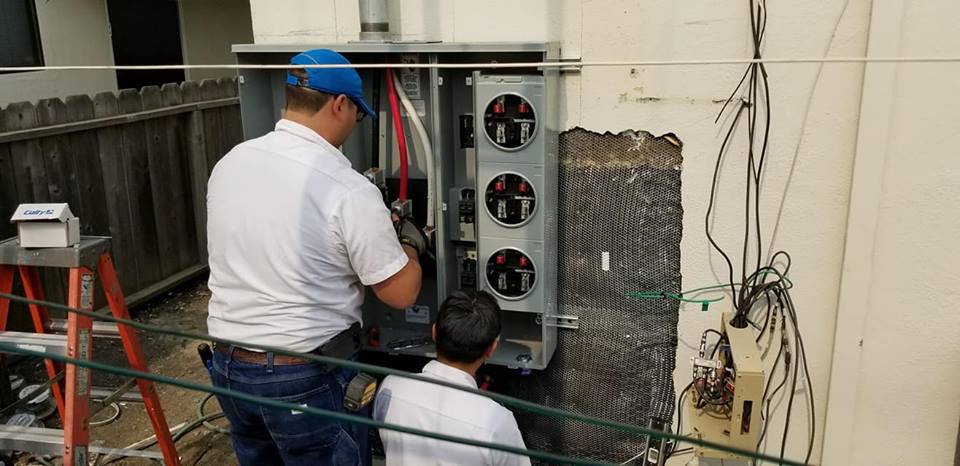
A qualified electrician can measure the actual load on the circuit, inspect the breaker for signs of wear, and check for wiring faults that are not visible from the panel. The electrician can also determine whether the breaker itself has degraded from repeated cycling and needs replacement. Wooding Electric provides residential and commercial electrical troubleshooting, repairs, wiring improvements, and related electrical services in San Jose and surrounding Bay Area cities. Having a professional assess the situation removes the guesswork and addresses the root cause rather than the symptom.
What to do instead of resetting again
When a breaker trips, the safe first step is to turn off or unplug all devices on that circuit before resetting the breaker. If the breaker holds, plug each device back in one at a time and run it for a few minutes. The device that causes the breaker to trip again is likely the source of the problem. That device may need repair or replacement, or it may simply be drawing too much power for the circuit. If the breaker trips with nothing plugged in, the fault is in the wiring or in a hardwired fixture, and a professional should inspect it.
If the breaker trips repeatedly even with the load reduced, the breaker itself may be failing. A breaker that feels warm to the touch, or that makes a buzzing sound, should be examined by a qualified electrician. Replacing a breaker is not a DIY job for most homeowners because it involves working inside the live panel. A professional can safely swap out a worn breaker and verify that the new one is properly sized for the circuit.
For ground faults, such as a breaker that trips when a particular appliance is used in a damp location, the solution often involves a GFCI (ground fault circuit interrupter) breaker or outlet. A regular breaker will trip on a ground fault only if the fault current is high enough. A GFCI device trips at much lower leakage current, which is a safety advantage. If a standard breaker trips only when a specific device is used near water, upgrading the protection to a GFCI may be the right fix, but that should be done by a professional.
The bigger picture of electrical safety
Circuit breakers are part of a system designed to protect people and property. That system works best when it is respected and maintained. Repeatedly resetting a breaker that continues to trip undermines the safety the breaker is meant to provide. It turns a protective device into a temporary patch, and it hides the real problem until that problem becomes dangerous.

For homeowners and business owners in the San Jose area, knowing when to stop resetting and start investigating is an important part of electrical safety. Wooding Electric provides residential and commercial electrical troubleshooting, repairs, wiring improvements, and related electrical services in San Jose and surrounding Bay Area cities. A professional evaluation can identify the cause of a recurring trip and restore the circuit to safe operation. The small effort of calling for help is much less costly than the consequences of ignoring a fault.
Understanding why a breaker trips and what repeated resetting does to the system gives you the knowledge to make a better decision the next time the lights go out. That knowledge is the foundation of sound electrical troubleshooting, whether you manage a home or a commercial building.